
Why Most Shopify Stores Fail to Track Real Profit (And How to Fix It)
 Brian @brian
·
·
9 min read
25 views
Brian @brian
·
·
9 min read
25 views
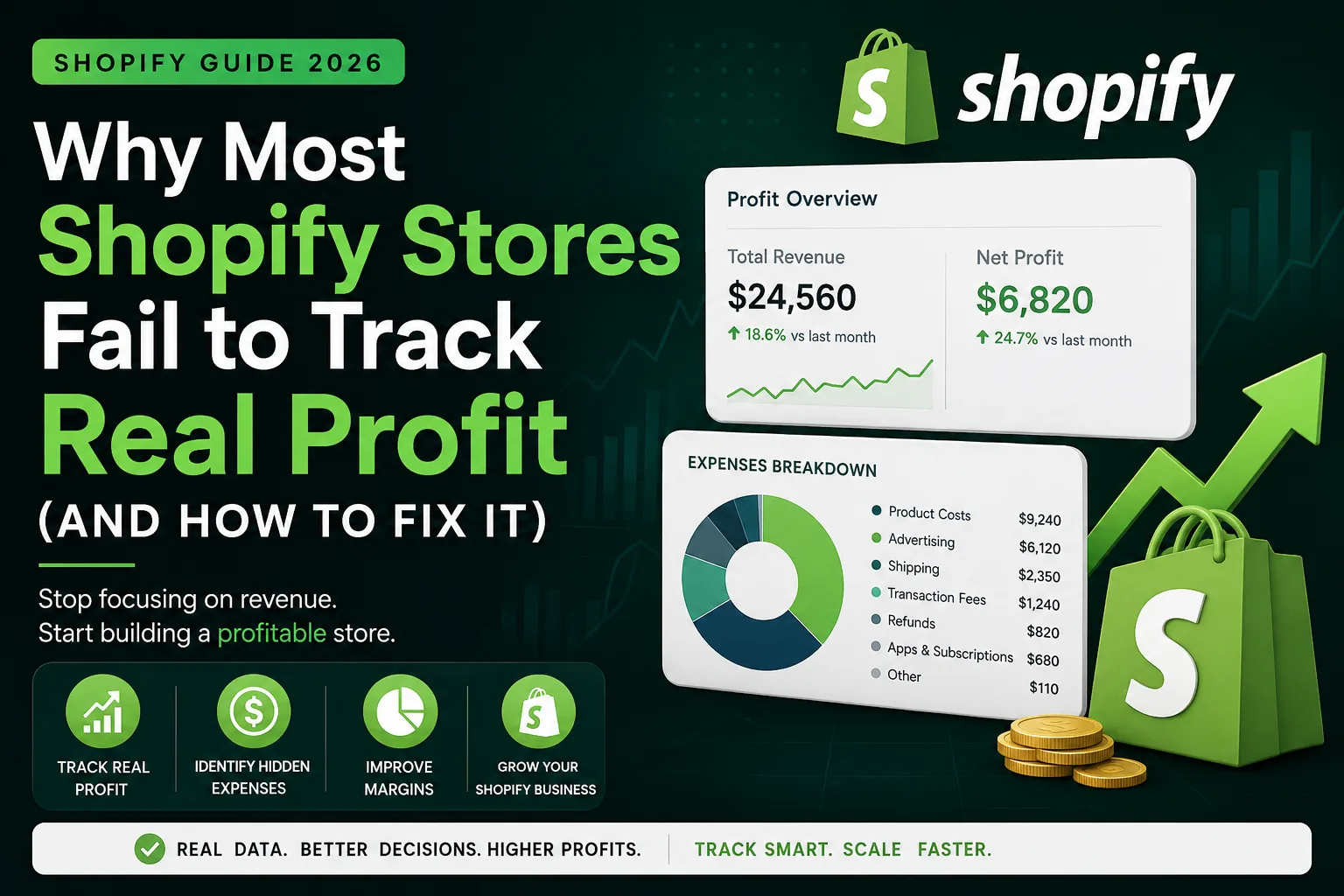
If you ask most Shopify store owners how their business is doing, they will usually share a revenue number. They might say their store generated $5,000 last month. Others might say they hit $50,000 or even $100,000 in sales. Across social media, it is common to see screenshots showing huge revenue milestones and impressive sales numbers. While these achievements can be exciting, they often hide an important reality that many Shopify merchants fail to recognize. Revenue is not profit.
A Shopify store can generate thousands of dollars in sales every month and still struggle financially. Some stores look very successful on the surface. But after expenses, they make very little money. Others are losing money entirely without realizing it. This misunderstanding is one of the biggest reasons ecommerce businesses struggle to grow sustainably. Store owners become focused on increasing sales while overlooking the metrics that truly matter.
Understanding Shopify profit is one of the most valuable skills an ecommerce entrepreneur can develop. When you know how much money your business keeps after paying every expense, you can make smarter decisions. You can scale with confidence and avoid costly mistakes. In this guide, we explain why Shopify merchants struggle to track profit. We cover common overlooked expenses. We show how successful businesses monitor profitability. We explain how to see your store’s full financial performance.
Shopify profit is the amount of money your business keeps after every expense has been deducted from revenue. Revenue represents the total amount of money customers spend in your store. Profit is the money you have left after you pay all your costs. These costs include product costs, ads, fees, shipping, refunds, software subscriptions, and other operating costs. Many new merchants mistakenly assume these numbers are the same. Unfortunately, that assumption can lead to serious financial problems.
Imagine a Shopify store generates $10,000 in monthly revenue. At first glance, that sounds impressive. However, if product costs total $4,000, advertising costs are $3,000, and shipping costs are $500, the profit drops.
If transaction fees are $300 and software subscriptions are $200, the actual profit is only $2,000. The store generated significant sales, but only a fraction of that revenue became income for the owner. This distinction becomes increasingly important as a business grows. If you want a deeper breakdown of this topic, read our guide: Why Shopify Revenue Is Not the Same as Profit.
https://nugglets.com/blog/why-shopify-revenue-is-not-the-same-as-profit/
One reason Shopify merchants focus heavily on revenue is because revenue is highly visible. Shopify dashboards prominently display sales numbers, making them easy to track and celebrate. Large revenue figures look impressive on social media, in business communities, and during conversations with other entrepreneurs. Unfortunately, revenue does not tell the complete story. A Shopify store making $100,000 per month can earn less profit than a $20,000 store. This can happen if expenses are not managed well.
Successful ecommerce operators understand that profitability matters more than sales volume. According to insights shared on the Shopify Blog at https://www.shopify.com/blog, Merchants who regularly check their financial performance often make better decisions. They manage inventory more effectively. They set advertising budgets more wisely. They plan for long-term growth more clearly. Instead of chasing vanity metrics, they focus on where their money comes from and where it goes.
One of the biggest challenges facing Shopify merchants is the number of expenses that quietly reduce profitability. These expenses often exist across multiple platforms, making them difficult to monitor consistently. Advertising costs are among the most significant. Many Shopify businesses depend heavily on paid traffic. They use sources like Facebook Ads, Instagram Ads, TikTok Ads, and Google Ads. Ads, and Google Ads. While these platforms can bring in strong revenue, they can also cut into profits if campaigns are not managed carefully.
Platforms such as TikTok Business at https://www.tiktok.com/business/en have made it easier than ever to reach potential customers. However, customer acquisition costs continue to rise as competition increases. Many merchants focus on sales generated from advertising while overlooking how much they spend to acquire each customer. Without tracking these numbers accurately, it becomes impossible to determine true profitability.
Product costs represent another major expense. Every item sold has an associated cost that directly impacts margins. As order volume increases, product expenses increase as well. Many dropshippers underestimate the impact product costs have on overall profitability. Small changes in supplier pricing can significantly affect margins over time.
Shipping expenses also play a major role. Some merchants offer free shipping to remain competitive. Others absorb unexpected shipping increases during peak seasons. These costs may seem manageable on individual orders, but they can accumulate quickly across hundreds or thousands of transactions. Ignoring shipping expenses often results in inaccurate profit calculations.
Payment processing fees create another hidden expense. Shopify Payments, Stripe, PayPal, and other processors charge fees on every transaction. While these fees appear small individually, they can amount to thousands of dollars annually for growing stores. Refunds and chargebacks further complicate profitability calculations. Customer refunds reduce revenue directly, while chargebacks may introduce additional penalties and administrative costs.
Software subscriptions represent a growing expense category for Shopify businesses. Modern ecommerce stores often depend on multiple tools for product research, analytics, customer support, email marketing, competitor monitoring, inventory management, and reporting. Each subscription may seem affordable on its own, but together they can significantly impact monthly profitability.
As Shopify stores grow, profit tracking becomes increasingly difficult. A store generating ten orders per month can often manage finances manually. A store generating hundreds or thousands of orders cannot. Growth introduces complexity. Merchants add more products, more suppliers, more advertising campaigns, more fulfillment partners, and more sales channels. Information becomes scattered across dashboards, spreadsheets, advertising accounts, supplier portals, and reporting platforms.
Without a centralized system, determining actual profitability becomes challenging. Many store owners spend hours switching between platforms attempting to understand performance. This fragmented workflow often results in missed expenses, inaccurate calculations, and poor decision-making.
The spreadsheet problem is a common example. Many Shopify merchants begin by tracking finances using spreadsheets. Initially, this approach works well. Spreadsheets are inexpensive, flexible, and familiar. However, as order volume grows, spreadsheets become difficult to maintain. Human error increases. Information becomes outdated. Duplicate entries appear. Important expenses are forgotten. Instead of simplifying operations, spreadsheets often become another source of frustration.
Successful Shopify merchants recognize the importance of data visibility. They understand exactly how their business is performing. They know which products generate the highest profit margins. They know which advertising campaigns deliver the strongest returns. They understand customer acquisition costs and lifetime value. They know which products should be scaled and which should be removed.
Having visibility into these metrics allows merchants to make informed decisions. Without visibility, growth becomes guesswork. Decisions are based on assumptions rather than data. Over time, this can lead to wasted advertising budgets, declining margins, and missed opportunities.
Understanding market demand is another important aspect of Shopify success. Merchants who combine profit tracking with market research often outperform competitors. Tools such as Google Trends at https://trends.google.com help identify products with growing search interest and seasonal demand patterns. This information allows merchants to identify opportunities before they become saturated.
Industry research platforms such as Statista at https://www.statista.com provide valuable insights into ecommerce trends, consumer behavior, and market growth. By combining financial data with market intelligence, Shopify merchants can make more strategic decisions regarding product selection, inventory planning, and advertising investments.
Competitor research provides additional opportunities for improvement. Successful store owners regularly monitor competitors to identify new products, pricing strategies, marketing trends, and customer preferences. Platforms such as Ahrefs at https://ahrefs.com/blog and Semrush at https://www.semrush.com/blog offer valuable insights into competitor traffic sources, keyword strategies, and content performance.
Although these tools are often associated with SEO, they can also reveal profitable opportunities within specific niches. Understanding what competitors are doing well allows merchants to refine their own strategies and avoid costly mistakes.
Several common mistakes prevent Shopify merchants from tracking profit accurately. One of the most frequent errors is ignoring advertising spend. Advertising is often the largest expense for ecommerce businesses. Failing to include ad costs creates unrealistic profit calculations and leads to poor decision-making.
Another mistake involves focusing exclusively on revenue rather than net profit. Revenue may indicate growth, but profit determines sustainability. Businesses survive because they generate profit, not because they generate sales.
Many merchants also underestimate subscription expenses. Each software tool adds another monthly cost. Over time, these costs can significantly reduce profitability if not monitored carefully.
Refund rates are another commonly overlooked metric. High refund rates reduce revenue, increase operational costs, and often indicate underlying problems with product quality or customer expectations.
Perhaps the most damaging mistake is making decisions without data. Guesswork may occasionally produce positive results, but long-term success requires accurate information. Merchants who rely on data consistently outperform those who rely on assumptions.
Top-performing Shopify merchants typically follow a structured profit tracking process. They track every revenue source. They record every expense. They monitor advertising performance closely. They review margins regularly. They eliminate underperforming products and scale profitable ones. Most importantly, they make decisions based on objective data rather than emotions.
As businesses grow, many merchants seek ways to centralize information. They do not want to switch between dashboards.
They prefer one system.
It should combine profit tracking, product research, supplier management, competitor monitoring, and order management. This reduces decision fatigue and improves visibility across the entire business.
If you want to better understand store profits, see our guide, How to Calculate Real Shopify Profit.
It offers a clear, step-by-step framework: https://nugglets.com/blog/how-to-calculate-real-shopify-profit/ Real Shopify Profit, at https://nugglets.com/blog/how-to-calculate-real-shopify-profit/, offers a clear step-by-step guide. You may also find our article on Best Dropshipping Tools in 2026 helpful.
Read it here: https://nugglets.com/blog/best-dropshipping-tools-2026/.
It can help you choose software that improves efficiency.
The future of Shopify analytics will be driven by visibility, automation, and data-driven decision making. Ecommerce competition continues to increase. Advertising costs continue to rise. Consumer expectations continue to evolve. Merchants who understand their numbers will have a significant advantage over those who do not.
Profitability, efficiency, and visibility will become even more important in the years ahead. Store owners who embrace analytics today will be better positioned to scale tomorrow. They will decide faster, spot opportunities sooner, and avoid many mistakes that keep businesses from reaching their full potential.
Many Shopify stores fail to track real profit because revenue is easier to see than expenses. Unfortunately, ignoring profitability creates substantial risks. A store can generate impressive sales numbers while producing very little actual income. By tracking expenses closely, Shopify merchants can build stronger businesses. They can make better decisions. They should watch margins often. They should review ad performance. They should know their customer acquisition costs.
At the end of the day, revenue may look exciting, but profit is what truly matters. Profit pays the bills. Profit funds growth. Profit creates stability. The most successful Shopify businesses are not necessarily the stores with the highest sales. They are the stores with the clearest understanding of where every dollar goes and how much money they actually keep. Merchants who want better visibility, smoother operations, and clearer store insights can use Nugglets.
Nugglets, at https://nugglets.com, keeps building tools for Shopify entrepreneurs.
These tools help them make smarter decisions and grow more profitable businesses.
Related real-profit guides
- Shopify profit tracker - move from theory to a real dashboard workflow
- Shopify revenue vs profit - dig deeper into why sales can be misleading
- Shopify profit and loss - track the costs that decide whether the store is healthy
- Ecommerce business dashboard - connect profit with orders, products, and operations
Run your whole store from one dashboard
Track orders, suppliers, inventory and real profit with Nugglets.
See NuggletsKeep reading
How to Start Dropshipping on Amazon 2026

How to Calculate Your Break-Even ROAS for Shopify


Comments 1
Good blog post