
How to Start Dropshipping on Amazon 2026
 Brian @brian
·
·
4 min read
8 views
Brian @brian
·
·
4 min read
8 views
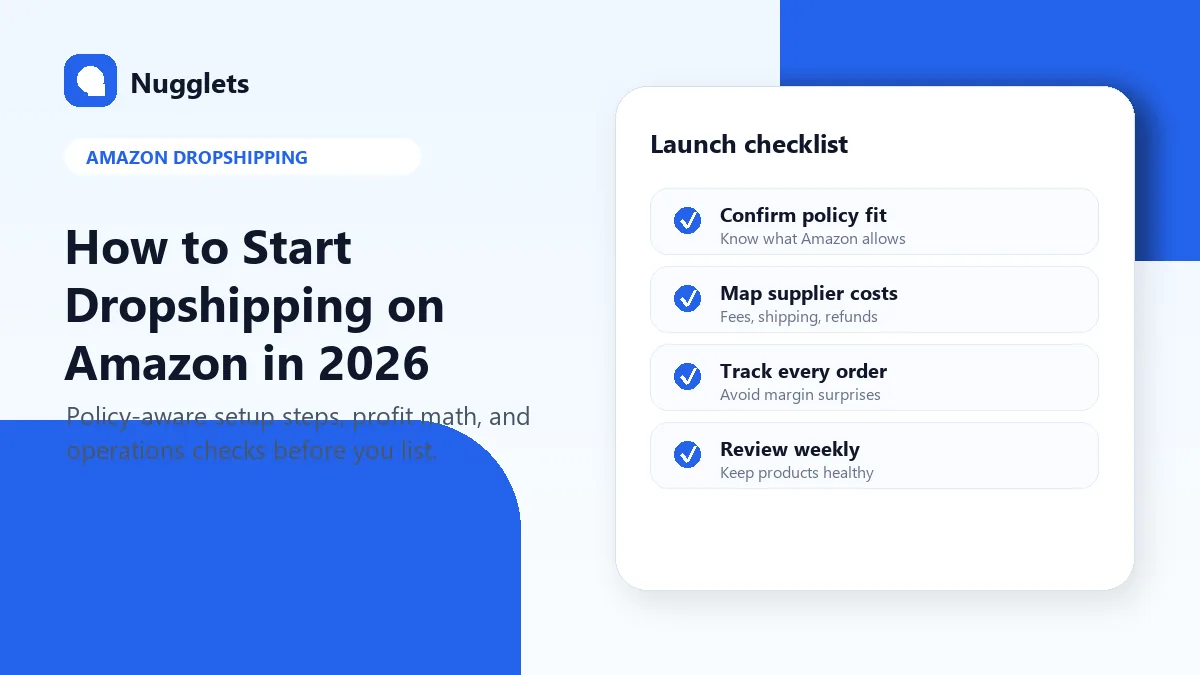
How to start dropshipping on Amazon 2026 is not just a listing question. It is an operations question. You need to know what Amazon allows, what your supplier can actually fulfill, and whether the product still has margin after fees, shipping, refunds, and customer service. A beginner can make a product look profitable in a spreadsheet and still lose money if the supplier ships late, adds branded paperwork, changes pricing, or creates refund pressure.
This guide gives you a practical setup path for beginners who want to test Amazon dropshipping without treating it like a shortcut. The goal is to help you validate policy fit, supplier reliability, product economics, and order tracking before you publish listings or spend money trying to scale. If you already run a Shopify or ecommerce store, the same discipline applies: the marketplace may be different, but profit, fulfillment, and customer experience still decide whether the store survives.
How to start dropshipping on Amazon 2026: quick answer
Start by reading Amazon's current drop shipping policy, then choose products only after you can prove supplier reliability, landed cost, delivery speed, return handling, and expected profit. Do not list products first and solve operations later. That order creates avoidable risk because every supplier issue becomes a customer issue attached to your seller account.
| Step | What to do | Why it matters |
|---|---|---|
| Policy check | Confirm your fulfillment workflow follows Amazon's drop shipping rules. | Account health matters more than a quick product test. |
| Supplier check | Verify stock, packaging, invoices, shipping speed, and return process. | Supplier mistakes become your customer experience. |
| Profit check | Estimate fees, product cost, shipping, refunds, and support time. | Revenue is not profit. |
| Tracking check | Record orders, supplier costs, and net profit from day one. | You need clean data before scaling. |
Start with Amazon policy before product research
Amazon's official drop shipping policy is the first source to review. The core idea is simple: the customer should understand that you are the seller responsible for the order. If a supplier's branding, packing slip, invoice, or return process points customers somewhere else, your operation can create risk. Read the policy yourself before building a workflow around secondhand advice, because marketplace rules matter more than a viral tutorial.
That means your supplier choice is not only about price. Ask how the item ships, what paperwork is included, how returns are handled, how quickly tracking appears, and whether the supplier can keep inventory stable. If the answer is vague, keep looking. A supplier who cannot explain their process before you send orders is unlikely to become more organized after volume increases.
Decide whether Amazon dropshipping fits your model
Amazon dropshipping is attractive because buyers already use the marketplace. But that convenience comes with tighter expectations. Customers expect accurate listings, reliable delivery, and clear support. Amazon also expects sellers to follow platform rules and maintain customer trust. If your current operation is informal, scattered across messages, or dependent on suppliers you have not tested, pause before listing.
The model tends to work best when you can build a repeatable back office. You need a product research process, a supplier checklist, a profit calculator, an order tracker, and a weekly review. Without that operating system, adding more listings only adds more ways for margin and service quality to slip.
Choose products with profit math, not excitement
The strongest beginner mistake is picking products because they look easy to sell. For Amazon dropshipping, every possible product needs a simple profit model before it reaches your account. Start with the selling price and subtract the costs you can reasonably predict. Then leave room for the costs you cannot predict perfectly, such as refunds, replacements, customer support, and supplier price changes.
- Product cost from the supplier
- Shipping cost and handling time
- Amazon referral and selling fees
- Expected refund or replacement cost
- Ad spend or promotion cost if you plan to use it
- Your minimum acceptable net profit per order
A dropshipping profit calculator helps you test that math before you commit. If the product only works when everything goes perfectly, it is not ready for a real store. Look for products where the margin still makes sense after a reasonable mistake, delay, or return.
Build a supplier checklist before you list
Your supplier is the hidden engine behind the customer experience. Before you publish a listing, collect the details you will need when orders begin arriving. Treat this as a qualification process, not a friendly conversation. Good suppliers should be able to answer operational questions clearly and consistently.
- Primary contact and backup contact
- Current wholesale or unit cost
- Shipping method and delivery window
- Return address and return rules
- Stock refresh cadence
- Whether neutral packaging is available
- How quickly tracking numbers are issued
- What happens when an item is out of stock
Keep these details in one place instead of scattered across email, chat, and spreadsheets. Nugglets includes supplier management so product costs and supplier notes can sit next to your orders and profit tracking. That context matters when you are deciding whether to keep, pause, or replace a product.
Create a listing quality checklist
Do not copy supplier content blindly. A good listing should match the product accurately, set clear expectations, and avoid claims you cannot support. For each product, review the title, images, description, dimensions, materials, delivery window, and return expectations. If the supplier's information is incomplete, ask questions before publishing.
Also decide what makes the product worth listing. Is the supplier reliable? Is the margin strong enough? Are returns likely to be low? Is the product easy to explain? Can you support customer questions? If you cannot answer those questions, the listing is not ready.
Track orders from the first sale
Once a product is live, the work shifts from setup to operations. Every order needs a clear status: paid, sent to supplier, shipped, delivered, refunded, or delayed. If you cannot see those states clearly, small issues become account-health problems. A few missed tracking updates can become a customer support pattern.
Use an order management workflow to review new orders daily. For each order, confirm the supplier received it, tracking is available, the customer experience is clean, and the profit still matches your estimate. If a supplier repeatedly misses the expected timeline, do not wait for the problem to become normal.
Review profit weekly, not only after payout
Amazon dropshipping can feel busy before it is profitable. That is why a weekly profit review matters. Look at product-level profit, refund pressure, supplier changes, shipping delays, and support issues. A product with many sales but thin net profit may not deserve more attention. A product with fewer sales but clean fulfillment and strong margin may be a better candidate to test further.
A dropshipping sales tracker helps compare revenue and profit over time. Use it to answer three questions: which products deserve more attention, which products need supplier renegotiation, and which products should be removed before they create more work.
Amazon dropshipping vs. Shopify dropshipping
Amazon gives you marketplace demand, but Shopify gives you more control over brand, checkout, email capture, and customer journey. Neither path is automatically easier. Amazon requires tighter policy awareness and marketplace discipline. Shopify requires more traffic building and conversion work. In both cases, the owner needs supplier tracking, order management, and profit visibility.
If you plan to test both, keep the financial workflow consistent. Compare products by net profit, not by platform excitement. A product that works on Shopify may not work on Amazon after fees and policy constraints. A product that sells on Amazon may not be a good brand fit for a Shopify store. Keep the numbers clean enough to compare.
Common beginner mistakes to avoid
- Listing products before checking Amazon's current drop shipping policy.
- Assuming supplier pricing will stay the same after orders increase.
- Ignoring packaging, invoices, and customer-facing supplier details.
- Tracking revenue but not net profit per order.
- Waiting until customer complaints appear before reviewing fulfillment.
- Scaling a product before refund and support patterns are visible.
None of these mistakes are dramatic on day one. That is what makes them dangerous. They become expensive only after you have more listings, more orders, and more customer expectations to manage.
FAQ
Can you dropship on Amazon in 2026?
Yes, but only with a workflow that follows Amazon's current policy. Review Amazon's official drop shipping policy before choosing suppliers or listing products.
What is the safest first metric to watch?
Net profit per order is the cleanest first metric. It forces you to include product cost, shipping, fees, refunds, and ad spend instead of celebrating revenue alone.
Should beginners start with Amazon or Shopify?
Amazon can put products near marketplace demand faster, while Shopify gives you more control over brand and checkout. Either way, the store needs clean supplier, order, and profit tracking.
What tools help Amazon dropshippers?
Use a profit calculator, supplier tracker, order management workflow, and sales tracker. The point is to know the true economics and fulfillment status before adding more listings.
Next step
If how to start dropshipping on Amazon 2026 is the question, the next step is to build the tracking layer before you list. Use Nugglets to model product cost, organize suppliers, watch orders, and compare real profit as you test.
Run your whole store from one dashboard
Track orders, suppliers, inventory and real profit with Nugglets.
See NuggletsKeep reading
How to Calculate Your Break-Even ROAS for Shopify


Comments 0