
Why Managing Multiple Shopify Stores Is Better with an All-in-One Platform
 Brian @brian
·
·
9 min read
17 views
Brian @brian
·
·
9 min read
17 views
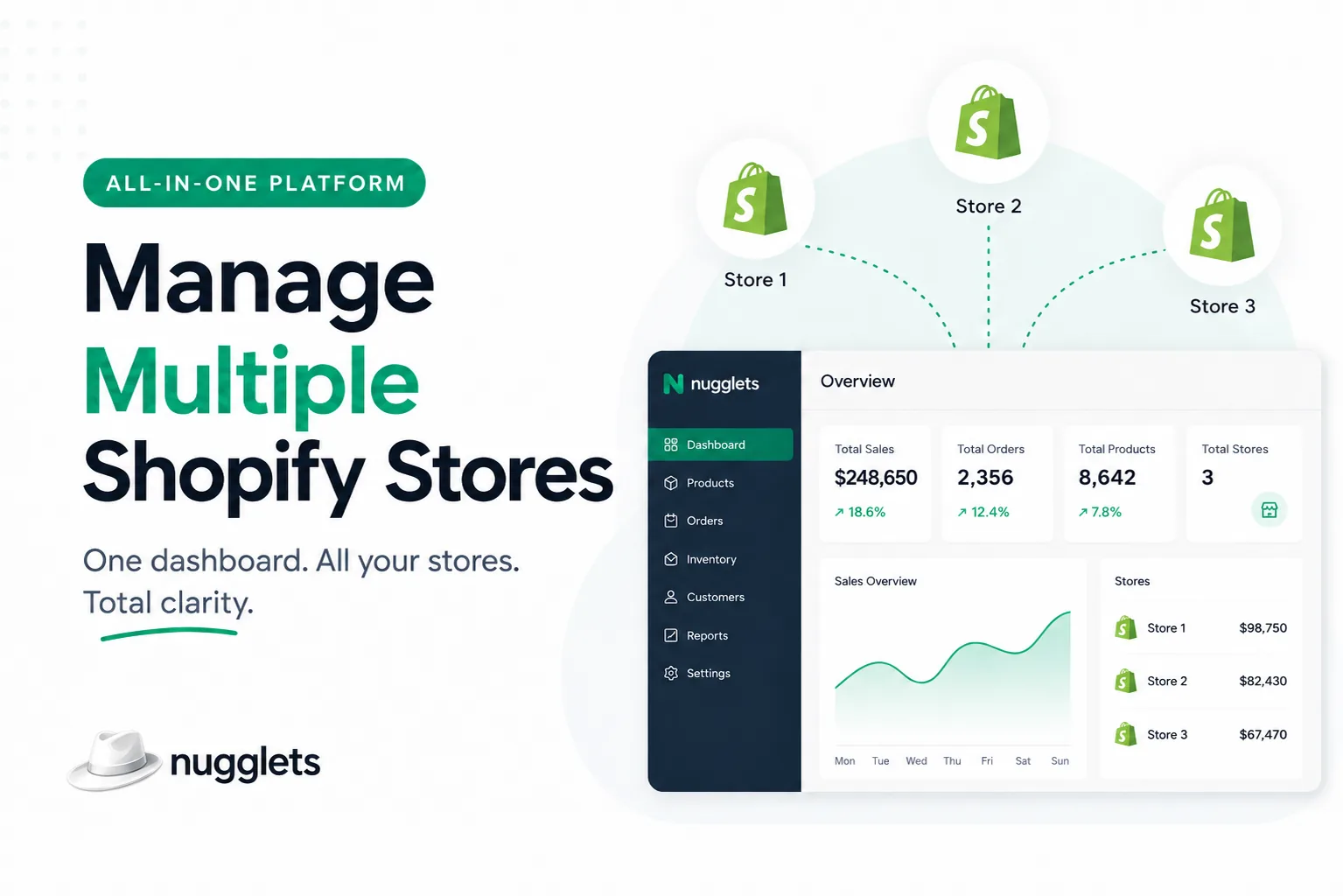
Running one Shopify store can already feel like managing a small digital city. Products need attention, orders keep arriving, inventory changes constantly, discounts come and go, and fulfillment data somehow always needs checking right when you are trying to do something else.
Add a second or third store, and the situation can quickly become less “organized ecommerce operation” and more “browser tabs performing an interpretive dance.”
That is where an all-in-one management platform becomes valuable.
By bringing multiple Shopify stores into one centralized dashboard, businesses can reduce repetitive work, improve visibility, and make faster decisions without constantly jumping between separate admin panels.
Nugglets is designed to support that experience by giving store owners a central place to connect, synchronize, and monitor multiple Shopify stores.
One Dashboard Instead of Several Separate Workflows
When every Shopify store is managed independently, even simple tasks can become repetitive.
You may need to:
-
Sign in to multiple stores
-
Review separate order lists
-
Check inventory in different dashboards
-
Track fulfillment independently
-
Compare reports manually
-
Repeat the same product or discount updates
An all-in-one platform reduces that fragmentation.
With Nugglets, each Shopify store can be connected as its own add-on configuration while still being managed from the same central platform. This allows store owners to maintain separation between individual businesses or storefronts without losing the convenience of a unified workflow.
Each store keeps its own connection, credentials, permissions, synchronization settings, and data while remaining accessible through one organized interface.
In other words, the stores can keep their individuality without behaving like distant relatives who refuse to sit at the same table.
Centralized Order Tracking
Orders are the heart of an ecommerce business, but tracking them across several stores can become unnecessarily complicated.
Nugglets can import Shopify orders from each connected store, allowing order activity to be tracked from one platform.
A centralized order view can help business owners:
-
Monitor sales activity across multiple stores
-
Identify which storefronts are receiving the most orders
-
Review order information without repeatedly switching accounts
-
Build a clearer picture of overall business performance
-
Reduce the chance of overlooking activity in a less frequently checked store
This becomes increasingly useful as a business grows. What feels manageable with one storefront can become difficult once several stores, brands, regions, or product lines are involved.
A shared dashboard creates a more complete operational picture.
Automatic Synchronization Keeps Data Moving
Store data changes constantly.
A new order can affect inventory. A fulfillment update can change an order’s status. A return can influence reporting. A product change may need to appear across connected systems.
Nugglets supports automatic synchronization intervals, including a recommended five-minute schedule.
With automatic synchronization enabled, supported Shopify data can remain current without requiring store owners to manually refresh or reimport information throughout the day.
Depending on the features enabled for a store, synchronization can include:
-
Products
-
Orders
-
Inventory
-
Fulfillment information
-
Returns
-
Discounts
-
Shipping and carrier data
-
Store locations
-
Reports and analytics
After connecting a store, the initial synchronization can be started using Sync now. Once the first synchronization is complete, the automatic schedule helps keep information updated over time.
This means fewer manual checks, fewer duplicated tasks, and fewer moments of asking, “Wait, is this number from today or from three coffees ago?”
Product Management Across Connected Stores
Products are rarely static.
Titles change. Pricing changes. Inventory changes. Descriptions need improvement. New products are introduced, and older products eventually need to be retired.
Nugglets supports importing products from Shopify so store information can be used throughout the platform.
When the appropriate features and permissions are enabled, Nugglets can also support:
-
Creating Shopify products
-
Updating Shopify products
-
Deleting Shopify products when they are removed from Nugglets
-
Using Shopify inventory data
-
Working with store-location information
This gives store owners more flexibility in how they manage their catalog.
Rather than treating each connected Shopify store as an isolated system, Nugglets can act as a centralized operational layer where product information can be reviewed and managed more consistently.
For businesses operating multiple storefronts, this can help reduce inconsistencies between product catalogs and make it easier to maintain repeatable product-management processes.
Inventory Visibility Without the Guesswork
Inventory becomes more complicated when products are spread across multiple stores or locations.
Without a centralized system, store owners may find themselves checking each Shopify store separately to answer basic questions:
-
Which store has inventory available?
-
Which products are running low?
-
Are inventory changes reflected in the dashboard?
-
Is a product available at more than one location?
-
Which storefront needs attention first?
Nugglets can use Shopify inventory and location data when the required features are enabled.
This gives businesses a more complete view of stock-related activity across connected stores and helps reduce the need for repeated manual checks.
Better inventory visibility can also support smarter planning. Store owners can more easily identify shortages, review store-specific activity, and understand how inventory changes relate to orders and fulfillment.
It does not magically restock your shelves, unfortunately. We checked. But it can make the restocking decision much easier.
Fulfillment, Shipping, and Returns in One Ecosystem
An order does not stop being important after checkout.
Store owners still need to understand:
-
Whether the order has been fulfilled
-
Which fulfillment information is available
-
Whether shipping or carrier data has changed
-
Whether a return has been created
-
How post-purchase activity affects store performance
Nugglets supports Shopify fulfillment data, shipping and carrier data, and returns data when those features are enabled.
Bringing this information into the same platform as products and orders gives store owners a more complete view of the customer journey.
Instead of looking at sales in one place and fulfillment in another, businesses can work with a broader operational picture that includes what happened before, during, and after the purchase.
This can be especially valuable when several Shopify stores are being managed by the same team.
Consistent Discount Management
Discounts can be useful for promotions, product launches, seasonal campaigns, customer retention, and the occasional “we ordered far too many of these” event.
Nugglets can support the creation, updating, and deletion of Shopify discounts when the corresponding feature and permissions are enabled.
For multi-store businesses, centralized discount functionality can help maintain more consistent promotional workflows.
Store owners can organize discount activity through the same platform used for product, order, and store management rather than treating promotions as a completely separate task.
This helps reduce administrative overhead and makes it easier to build repeatable campaign processes across multiple storefronts.
Reports and Analytics Across the Business
Each Shopify store may tell part of the story, but business owners often need to understand the larger picture.
When reports remain separated by store, comparing performance may require exporting files, opening spreadsheets, and manually combining data.
That process works, but so does carrying groceries one item at a time. There is usually a better approach.
Nugglets supports Shopify reports and analytics data when enabled through the store configuration.
Centralized reporting can help businesses:
-
Compare performance between connected stores
-
Identify stronger and weaker product categories
-
Review sales activity from a broader perspective
-
Track store-level differences
-
Make decisions using more complete information
-
Reduce reliance on manually assembled reports
An all-in-one platform does not just collect data. Its real value comes from making that data easier to understand and act upon.
Flexible Permissions for Every Store
Not every business needs exactly the same Shopify functionality.
One store may only need product and order imports. Another may require inventory, fulfillment, returns, discounts, reports, shipping data, and product publishing.
Nugglets allows supported features to be selected individually for each Shopify store.
Available options can include:
-
Importing products
-
Creating and updating products
-
Deleting products
-
Managing discounts
-
Importing orders
-
Using inventory data
-
Using fulfillment data
-
Using returns data
-
Using reports and analytics
-
Using customer context
-
Using store locations
-
Using shipping and carrier data
-
Reading extended order history
-
Supporting Shopify app proxy functionality
Required Shopify scopes are generated based on the selected features.
This gives businesses control over what each connected store allows Nugglets to access and manage.
For a complete setup, enabling all available features provides the broadest platform functionality. However, the configuration remains flexible enough to support stores with more limited requirements.
Separate Store Connections with Centralized Control
A strong multi-store platform needs to balance two things:
-
Each store must remain independently configured.
-
The overall management experience should remain centralized.
Nugglets supports separate Shopify add-on configurations for individual stores.
Each store can have its own:
-
Shopify app
-
Client ID
-
Client Secret
-
Permissions
-
Feature selection
-
Synchronization schedule
-
Connection status
-
Last synchronization time
This structure helps prevent one store’s configuration from becoming tangled with another while still giving the business one central place to manage everything.
It is organization without overcomplication, which is a rare and beautiful thing in software.
Better Scalability as the Business Grows
The real advantage of an all-in-one platform is not limited to today’s workload.
It also prepares the business for future growth.
A company may begin with one Shopify store and later expand into:
-
Multiple brands
-
Regional storefronts
-
Wholesale and retail stores
-
Separate product categories
-
International stores
-
Client-managed stores
-
Test or development storefronts
Without a centralized platform, every additional store adds another independent workflow.
With Nugglets, new Shopify stores can be added as separate configurations while continuing to operate within the same management environment.
This makes growth more manageable because the operating model does not need to be reinvented every time a store is added.
Reduced Manual Work Means More Time for Growth
Every minute spent switching dashboards, checking sync status, comparing inventory, and copying information between systems is time that cannot be spent improving the business.
Centralization helps reduce that operational friction.
By using Nugglets to connect and manage multiple Shopify stores, businesses can spend less time on repetitive administration and more time on work that creates value, including:
-
Product research
-
Catalog improvement
-
Customer service
-
Marketing
-
Supplier management
-
Pricing strategy
-
Business analysis
-
Store expansion
The platform handles the flow of supported store data so owners and teams can focus on what the data actually means.
A More Organized Way to Manage Shopify
Managing multiple Shopify stores does not have to mean maintaining multiple disconnected workflows.
An all-in-one platform gives businesses a central place to monitor store activity, synchronize data, manage supported features, and maintain visibility across the entire operation.
Nugglets supports this through:
-
Multiple Shopify store connections
-
Centralized order tracking
-
Product importing and management
-
Inventory and location data
-
Fulfillment and returns visibility
-
Shipping and carrier information
-
Discount management
-
Reports and analytics
-
Flexible Shopify permissions
-
Automatic five-minute synchronization
-
Manual Sync now controls
-
Independent configuration for every store
The result is a cleaner, more scalable way to run a multi-store ecommerce business.
Because growing your Shopify operation should mean selling more products—not collecting more login screens.
Related multi-store hub
- Read the complete managing multiple Shopify stores guide - this is the main hub for this topic
- Manage multiple Shopify stores from one dashboard - centralize the daily operating view
- Ecommerce business dashboard - connect multi-store work to owner-level decisions
- Shopify profit tracker - track true profit across stores
Run your whole store from one dashboard
Track orders, suppliers, inventory and real profit with Nugglets.
See NuggletsKeep reading
How to Start Dropshipping on Amazon 2026
How to Calculate Your Break-Even ROAS for Shopify


Comments 0