
Should You Open a Second Shopify Store? How to Decide
 Brian @brian
·
·
10 min read
5 views
Brian @brian
·
·
10 min read
5 views
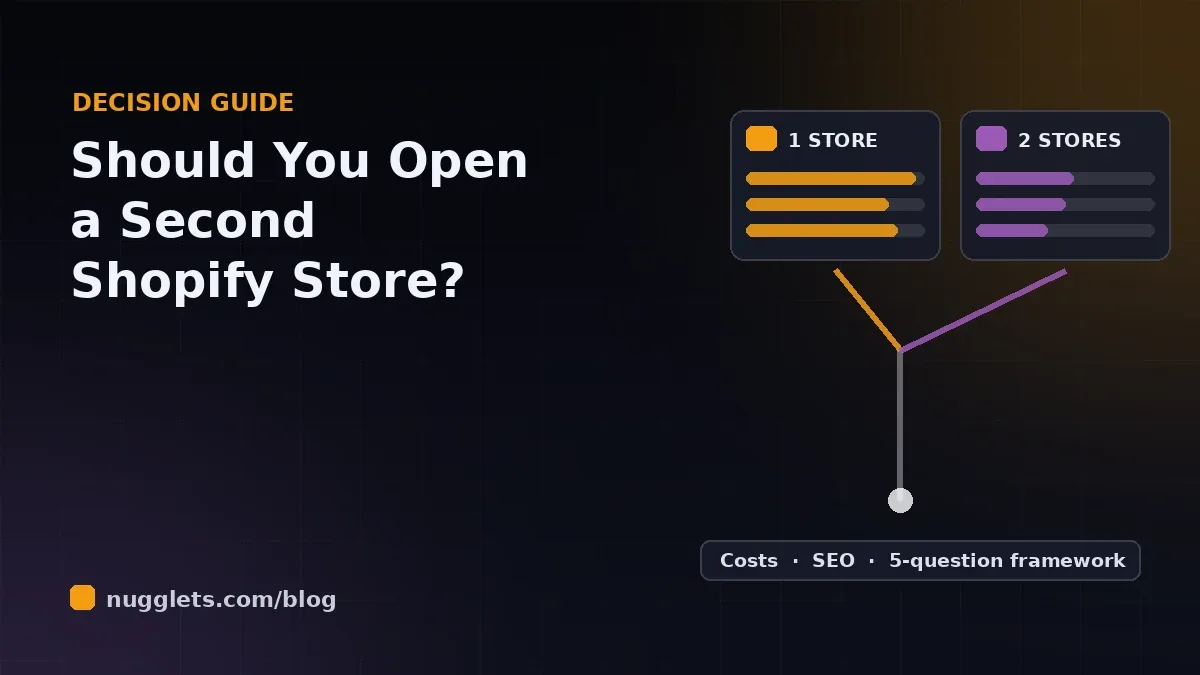
Somewhere around the first year of steady sales, almost every Shopify owner has the same thought: maybe I should launch a second store. A new niche looks tempting, a supplier offers a new product line, or international orders start trickling in. But managing multiple Shopify stores is a genuinely different job from running one well, and the decision deserves more than a weekend impulse.
This guide is a practical decision framework for one store versus multiple. It covers the situations where a second store is clearly the right call, the situations where it quietly destroys margin and momentum, the true costs involved, and the questions to answer before you commit. By the end you should know which side of the line your business sits on.
The Real Question: New Store, or New Channel for the Same Store?
Most "should I open a second store" dilemmas are actually about something else: reaching a new audience. A second Shopify store is only one way to do that, and often the most expensive one. Before comparing options, be precise about what you are trying to add. New country? New product category? New customer type, like wholesale buyers? New brand identity entirely?
Each of those has a lighter-weight alternative inside your existing store: Shopify Markets for international selling, collections and navigation for new categories, B2B features or password-protected pricing for wholesale, and a refreshed theme for repositioning. A second store is the right tool only when the thing you are adding cannot share a domain, a catalog, or a brand with what you already have.
One Store vs. Multiple Stores: The Trade-Offs at a Glance
Before digging into individual scenarios, it helps to see the two paths side by side across the dimensions that matter most day to day.
- Branding. One store keeps a single, compounding brand identity. Multiple stores let each audience get a message built purely for it, at the cost of building each reputation from scratch.
- SEO. One store concentrates every article, backlink, and product page into one domain's authority. Multiple stores split that authority, and each new domain starts at zero in search.
- Costs. One store pays for one plan, one app stack, and one theme. Each additional store repeats nearly the entire fixed-cost stack.
- Operations. One store means one order queue and one inventory count. Multiple stores multiply every routine task and introduce sync problems between catalogs.
- Data. One store gives you one clean customer list and one analytics property. Multiple stores fragment customer history, which weakens email flows, lookalike audiences, and lifetime-value math unless you consolidate reporting externally.
- Risk. One store is a single point of failure for policy issues or platform problems. Multiple stores spread that risk, which is part of why serious multi-brand operators accept the overhead.
Notice the pattern: multiple stores win on focus and risk separation, one store wins on cost, data, and compounding growth. The framework below is essentially a test of whether focus and separation matter enough in your case to pay the compounding penalty.
When a Second Shopify Store Makes Sense
You are launching a genuinely separate brand
If the new products would confuse or dilute your existing brand, separation is healthy. A store known for minimalist home goods will struggle to sell gaming accessories from the same domain, no matter how good the products are. Different brand, different audience, different story: that is the cleanest case for a second store.
You need different pricing for different buyers
Wholesale versus retail is the classic example. B2B buyers expect case quantities, negotiated pricing, and net payment terms that would clutter a consumer storefront. Many operators run a dedicated wholesale store precisely so the retail experience stays simple.
Your regions need more than translation
Markets handles currencies and languages well, but some regional differences run deeper: different product assortments for regulatory reasons, region-specific fulfilment partners, or a local entity that must own the transactions. When the region needs its own catalog and legal setup rather than just its own currency, a separate store starts to earn its keep.
You are testing a niche you might sell later
A store you may spin off or sell someday is easier to value and transfer when it was separate from day one, with its own domain, analytics history, and customer list.
When You Should Not Open a Second Store
The wrong reasons are more common than the right ones, and they usually look like growth.
- Chasing a trend product. If the product fits your existing audience even loosely, launch it as a collection first. You can always graduate it to its own store after it proves demand; you cannot easily refund the months spent building a storefront for a product that fizzled.
- Escaping a messy store. A disorganized catalog or an underperforming theme follows you to store two, because the operator is the same. Fix the system, not the address.
- Splitting an audience that is actually one audience. Two stores selling similar products to similar people divides your content, your backlinks, and your repeat-customer data across two domains. Google now sees two thin sites instead of one strong one, and your email list fragments the same way.
- Assuming two stores means double revenue. Revenue does not duplicate; work does. Every launch task you did once, you now maintain twice, forever.
The True Cost of a Second Shopify Store
The subscription is the smallest line item, and per Shopify's pricing it applies separately to every store you run. The full bill looks more like this.
Fixed platform costs double. A second store means a second plan, a second set of paid apps (reviews, email, upsells, subscriptions all charge per store), a second theme license, and a second domain. For a typical small store, that bundle lands in the low hundreds of dollars per month before a single ad runs.
Marketing starts from zero. The new domain has no SEO authority, no pixel data, no email list, and no social proof. Paid acquisition runs expensive during the learning phase, and organic traffic takes months to compound. Budget for the new store to lose money for a quarter or two.
Operations multiply quietly. Two order queues, two inventory counts, two sets of supplier conversations, two admin dashboards to check every morning. If the stores share physical stock, you also inherit the inventory sync problem, and reconciling numbers by hand across stores is exactly how sellers end up flying blind on margin, a failure mode we break down in managing multiple Shopify stores without losing profit.
Your attention divides. This is the cost operators underestimate most. Every hour spent on store two is an hour store one no longer gets, and store one is the proven business.
A Five-Question Decision Framework
Answer these honestly; the pattern of answers makes the decision for you.
- Is store one running without you? If daily operations still depend on your personal attention, a second store borrows time you do not have. Systems first, expansion second.
- Would the new venture confuse your current customers? If yes, that argues for a separate store. If your existing audience would happily buy the new products, that argues for a collection instead.
- Can you fund six months of losses? New stores rarely break even quickly. If the budget for store two comes out of store one's ad spend, you are trading proven growth for speculative growth.
- Does the new store need its own inventory, pricing, or legal entity? Genuine structural differences justify separation. Cosmetic differences do not.
- Do you have a way to see both stores' numbers in one place? If you cannot compare profit per store side by side, you will not know whether the expansion is working. A consolidated ecommerce business dashboard stops the second store from becoming a black box.
Three or more answers pointing toward separation, backed by funding and a stable first store, is a green light. Anything less, and the smarter move is almost always to grow inside the store you already have.
If You Do Launch Store Two: Set Up for Multi-Store Life on Day One
The operators who thrive with multiple stores treat them as one business with two storefronts, not two businesses. That mindset shows up in four early decisions.
First, centralize reporting immediately: one place where orders, costs, and profit for both stores land, so Monday mornings start with one view instead of two tabs. Second, standardize your SKUs across stores before listing a single product, because every inventory and reporting tool downstream depends on them matching. Third, decide who owns what: even a two-person team needs clarity on who answers store two's support inbox. Fourth, schedule a weekly per-store profit review, because blended numbers hide a failing store inside a successful one. Our guide to managing multiple Shopify stores without chaos walks through the daily and weekly routine in detail.
A Realistic Timeline for Store Number Two
Expansion goes better when the calendar expectations are honest. The first month is setup: brand, theme, catalog, payment and shipping configuration, and the app stack, all while store one still needs its normal attention. Months two and three are the expensive learning phase, where ad platforms gather data and conversion rates sit below what you are used to. Somewhere between months three and six, a viable store finds its footing: ad efficiency stabilizes, organic traffic begins to register, and repeat customers appear.
Two checkpoints keep the experiment disciplined. At ninety days, the question is direction: are acquisition costs trending down and conversion trending up? At six months, the question is money: is the store on a credible path to covering its own fixed costs? A store that fails the six-month checkpoint rarely fixes itself with more time, and folding it back into the main store as a collection is not a failure, it is the framework working as intended.
Frequently Asked Questions
Do I need a separate Shopify subscription for each store?
Yes. Each store is a separate account with its own plan, apps, and theme. There is no multi-store bundle discount, so fixed costs scale linearly with store count.
Will opening a second store hurt my SEO?
It can if the stores overlap. Splitting similar content across two domains dilutes authority, and copying product descriptions between them risks duplicate-content problems. Distinct brands with distinct content avoid the issue.
Can I manage multiple stores from one login?
Yes. One Shopify account can own several stores and switch between them in the admin, but each store's data, apps, and settings stay fully separate, which is why consolidated reporting requires an external tool.
Final Thoughts: Expansion Is a Multiplier, Not an Addition
A second Shopify store multiplies whatever you already have. A profitable, systemized store becomes a portfolio; a fragile store becomes two fragile stores. Run the five questions, price the real costs, and if the answers point to separation, commit properly: separate brand, centralized numbers, and a plan for the six months before store two pays for itself.
And if the answers point the other way, take it as good news. The cheapest growth available is usually hiding inside the store you already run.
Quick Recap: The Second-Store Checklist
If you skimmed to the end, here is the whole decision in one pass. Open a second Shopify store when you are building a genuinely separate brand, serving wholesale and retail buyers with different pricing, operating regions that need their own catalogs or legal entities, or incubating a niche you may sell later. Stay with one store when the new idea shares your current audience, when the budget would come out of proven ad spend, or when store one still depends on you for daily operations.
Before launch day, make sure four things are true: store one runs on systems rather than heroics, you can fund at least six months of losses, your SKU conventions are standardized across both catalogs, and a single dashboard will show per-store profit from the first order. With those in place, a second store is a calculated expansion instead of an expensive experiment.
Run your whole store from one dashboard
Track orders, suppliers, inventory and real profit with Nugglets.
See NuggletsKeep reading
Managing Multiple Shopify Stores as a Small Team
How to Sync Inventory Across Multiple Shopify Stores


Comments 0